
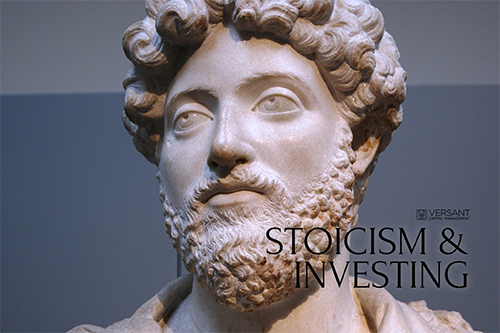
Preparing for reality
By Matt Miller, CFP
Stoicism is a school of philosophy founded in Athens in the third century BC. At the core of its teachings is eudaimonia, a state of happiness or blessedness. The path to eudaimonia is practical and is something we can use and benefit from today in both our everyday lives and investment portfolios. One of the most well-known practitioners of stoicism was Marcus Aurelius, who journaled about it in his book titled Meditations.
Achieving eudaimonia1 is found in accepting the moment as it presents itself, by not allowing yourself to be controlled by the desire for pleasure or by the fear of pain. It’s about the joy and abundance that can only be found in the present moment, accepting life on life’s terms, and being prepared for the unprepared. It’s about letting go of the things you can’t control while focusing on the things you can.
Sh*t happens. So simple, yet so profound.
Stoics would contemplate the tough times during good times, knowing that difficult events would eventually come. They would try to feel pain to help prepare for what was ahead. They understood that the quality of life wouldn’t be dictated by what happened to them, necessarily, but instead by how they reacted to what happened to them. They focused on what they could control. It isn’t coincidental that stoics were also successful investors.
Just as we understand today, stoics knew that the quality of an investment experience could be more negatively influenced by their personal behaviors and biases than by the behavior of their investments. Even with a professional portfolio evaluation, ineffective investments can happen. Markets go down. Sh*t happens. Pandemics happen. All are events that are out of our control. So, why do we struggle with them?
Wall Street and the media often present storylines that focus on the things out of our control as the keys to a good investment experience, such market performance, knowing when to buy and sell, or taking a “bet” on a new stock. Instead, the secret to a good investment experience may have more to do with the things we can control, like our behavior and curbing personal biases that get in the way of having a good long-term financial outcome.
Pain seems eternal when we are in the middle of it, yet we forget about it so quickly! Just 16 months ago, we saw the market spiral downward as we faced a global pandemic. Now, speculative investors are chasing investment prospects like Dogecoin. As investors, our aversion to risk is highly correlated with our current environment. Things aren’t as scary when they are out of sight2. Our fear of storms decreases each day that passes since the last one.
At Versant Capital Management, we build investment portfolios with the expectation that a storm could hit any day. This approach allows us to focus on the things we can control. That’s a powerful mindset in both investing and life. Markets will go up. Markets will go down. Yet, the quality of our overall investment experience may depend on how we react to what happens, rather than what happens.
Matt Miller, CFP®, is a senior client associate at Versant Capital Management, a wealth management and investment firm helping people with their financial and life goals since 2004.

Disclosure: For complete information on your tax situation, you should always consult with a qualified tax advisor. Any tax-related material contained within this article is subject to the following disclaimer required pursuant to IRS Circular 230: Any tax information contained in this communication (including any attachments) is not intended to be used and cannot be used for purposes of (i) avoiding penalties imposed under the United States Internal Revenue Code or (ii) promoting marketing or recommending to another person any tax-related matter. Please remember that past performance is no guarantee of future results. Different types of investments involve varying degrees of risk, and there can be no assurance that the future performance of any specific investment, investment strategy, or product (including the investments and/or investment strategies recommended or undertaken by Versant Capital Management, Inc. [“Versant]), or any non-investment related content, made reference to directly or indirectly in this commentary will be profitable, equal any corresponding indicated historical performance level(s), be suitable for your portfolio or individual situation or prove successful. Due to various factors, including changing market conditions and/or applicable laws, the content may no longer be reflective of current opinions or positions. Moreover, you should not assume that any discussion or information contained in this commentary serves as the receipt of, or as a substitute for, personalized investment advice from Versant. Versant is neither a law firm, nor a certified public accounting firm, and no portion of the commentary content should be construed as legal or accounting advice. A copy of Versant’s current written disclosure Brochure discussing our advisory services and fees continues to remain available upon request or at www.versantcm.com. Please Remember: If you are a Versant client, please contact Versant, in writing, if there are any changes in your personal/financial situation or investment objectives for the purpose of reviewing/evaluating/revising our previous recommendations and/or services, or if you would like to impose, add, or to modify any reasonable restrictions to our investment advisory services. Unless, and until, you notify us, in writing, to the contrary, we shall continue to provide services as we do currently. Please Also remember to advise us if you have not been receiving account statements (at least quarterly) from the account custodian. Historical performance results for investment indices, benchmarks, and/or categories have been provided for general informational/comparison purposes only, and generally do not reflect the deduction of transaction and/or custodial charges, the deduction of an investment management fee, nor the impact of taxes, the incurrence of which would have the effect of decreasing historical performance results. It should not be assumed that your Versant account holdings correspond directly to any comparative indices or categories. Please Also Note: (1) performance results do not reflect the impact of taxes; (2) comparative benchmarks/indices may be more or less volatile than your Versant accounts; and (3) a description of each comparative benchmark/index is available upon request.
